
For the past two months I have been engulfed by family archives that my sister sent me in the wake of the sale of the old family home in Virginia. It had been in the family for 110 years. My grandfather built it in 1915 and Lois and David had taken care of it for the past forty. There was one old large chest in the living room that had patiently received albums, notebooks, loose photos and other memorabilia over many decades. She asked me to sort it out. Five large boxes.
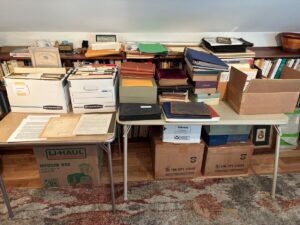
But this wasn’t simply the kind of thing a hardware store would do to sort the screws, bolts, chicken wire, and hammers into their proper aisles. It soon became an awakening of memory, indeed, an inhabiting of a memory that had been passed on to me willy-nilly in the accelerating years of a full life. And so, in my final years I am given a chance to pause and to look back at the long trail behind me. There were my parents and the city of Washington, the dairy farm in Loudoun County, Virginia, and the schools that educated me. Beyond them, my grandparents. Long-term readers of these journals would recognize my mother’s parents, who went to Cyprus in 1923 to supervise the reopened copper mines that had furnished copper for Agammemnon’s troops (Iliad, Book 11). That was already a book, Mining Memories on Cyprus, 1923-25.
But the trail continued to great-grandparents and their relatives. Best known to me was my paternal great-grandfather, Shepard Everett, who was wounded in the morning of September 17, 1862, at Antietam, Maryland—the bloodiest day of battle in American history. There were fragments of the letter he sent his father three days later detailing his experience and his good prospects of recovery. (I am, of course, here as a proof.) There were two other Union soldiers (Petersburg, Virginia, and New Bern, North Carolina). David Buckingham, my maternal great-grandfather, wrote in an amazingly elegant script that Petersburg was a slaughter unlike anything he had ever seen.
And it went back further to “Sheppie’s” mother, who left behind not only letters but the funeral sermon for her brother, who died falling off the mast of a passenger ship on the way back to Boston for Christmas in 1831. The sermon, published in 1832, was delivered by a deeply Calvinist preacher who, using Job 9:12, tried to discern the ways of God in this tragic accident. (“Behold, he taketh away, who can hinder him? Who will say unto him, What doest thou?”) He took ten pages of close theological argument to do it. What, I wondered, did it do to provide solace for the family?
And there were genealogies stretching back to Roger Williams and to four passengers on the Mayflower. (No, my mother never joined the Society: “Who wants to sit around with a bunch of old ladies talking about the past?” she said.) And so they didn’t. There was a letter my father wrote to his parents on August 10, 1944, while he was stationed at Pearl Harbor, supervising some of the docks. After ten days of a news blackout, he reported: “…the dock I have charge of for the arriving division was used for his [President Roosevelt’s] arrival. We all had to dress in whites + it was a most impressive scene. After all the years in Washington I had the closest view of him ever—only a few feet. He looked very much older and worn then I had imagined. … Gen. McArthur’s arrival was timed within an hour of the president’s + it was quite impressive to see the greeting of the two.” He had never mentioned this experience to any of us.
The boxes are full of well-worn albums and memorabilia with their evidence of very sorrowful matters as well as happy occasions, some known, some intimated, some completely unknown to me until now. I may share some more in the coming weeks.
Meanwhile, I find a deepened sense of being in the “ever-rolling stream” that “bears all who breathe away,” as the old hymn reads. All these documents remind me that I am in a small boat flowing in that stream. They also remind me of the causes that shaped these ancestors’ lives—preserving the Union, ending slavery, arguing in and with the church, sustaining and enhancing the lives around them, honoring the dead and the dying, selling merchandise at a fair, fixed price—matters menial as well as grand. Womb gave life to womb, seminal packets flowed from son to son.
I am very aware that many, probably most, people do not have such tangible bearers of memory. They soon reach the “brick wall” of slavery or the silence of the millions of native people whose DNA also flows in the lives of many Americans, including Sylvia’s, or the ashes of war in Europe, the haze of the Pale of Settlement and the Holocaust. And so we absorb and enter into the memories of others, trying to patch together the story that is us, a story that begins long before we were born and stretches in some form, whether biological or cultural, to generations yet to be born. The light is constantly flickering. It is constantly in need of new energy, new bearers of the spirit that embraces us all. I will keep sorting, scanning, and sharing. How about you? What is the stream you are in?
Thank you so much for sharing this!
I’m also in that stream of reminders of my family, reading letters from my young father to my young mother. Learning more about myself as I read comments about me in my college yearbook. Seeing my four brothers in a new light. How fortunate you are to be the keeper of this unique history.